“
"But for him the war would have been lost"
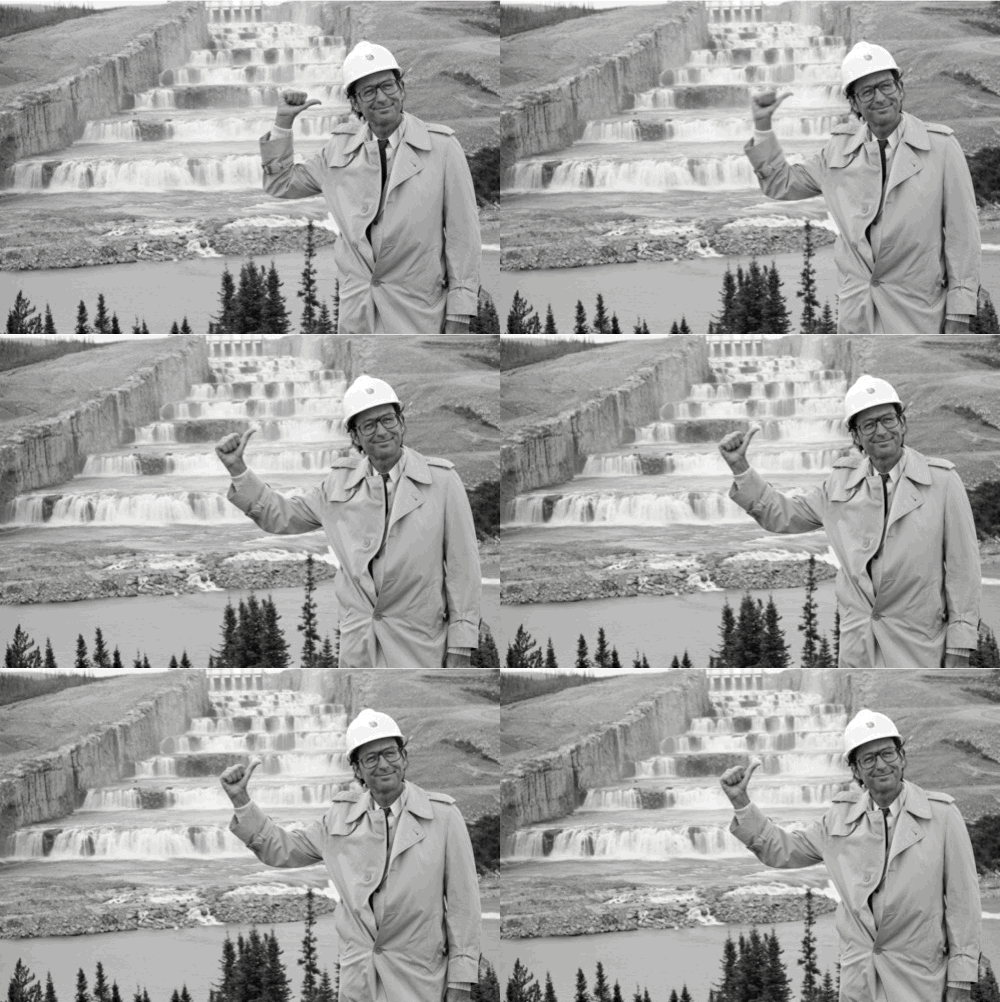
Clarence Decatur Howe propelled Canada out of its agricultural past into the world's fourth-largest industrial power in just five years. As Minister of Munitions and Supply from 1940 to 1945, this MIT-trained engineer oversaw $9.5 billion in war production from a nation of just 11 million people, producing more military vehicles than Germany, Italy, and Japan combined. His real talent though was not just in wartime feats but also in creating capabilities Canada had never had, building industries from scratch that would fuel the economy for generations.
Born on January 15, 1886, in Waltham, Massachusetts, Howe moved to Canada in 1908 as a 22-year-old engineering professor at the University of Dalhousie. By 1916, he had founded C.D. Howe and Company, which became the world's leading grain elevator designer. Prime Minister Mackenzie King brought him into Cabinet in 1935, where he would serve non-stop for 22 years, earning the nickname "Minister of Everything."
When the war began in 1939, Canada had almost no industrial war capacity. The country had four shipyards, 2,000 skilled shipwrights, and did not produce any heavy bombers. Within months of his appointment on April 9, 1940, Howe exercised powers under the War Measures Act to mobilize any industry, take property, and create corporations without parliamentary approval.
His innovation was the Crown Corporation model. Howe set up 28 government-owned companies, including Victory Aircraft, which produced 422 Lancaster bombers, starting from blueprints in January 1942 to the first flight by August 1943. He recruited 107 "Dollar-a-Year Men," top executives who worked for minimal government pay while they continued to receive a salary from their companies.
The numbers tell a compelling story. Over the course of the war, Canada produced 16,400 aircraft, 815,729 military vehicles, and 600 ships. The country supplied 40% of Allied aluminum, 95% of Allied nickel, and 100% of Allied uranium. The economy boomed, as unemployment dropped from 11.4% to 1.4% and Canada's GNP nearly doubled from $5.6 billion to $11.8 billion. The Arvida aluminum smelter in Quebec, using Canada's abundant hydroelectric resources, became the world's largest producer. It was so vital that 3,000 soldiers defended it, and it was declared a secret military installation. As Lord Beaverbrook once said, C.D. Howe was “one of a handful of men of whom it can be said, 'But for him the war would have been lost.'”
While other nations struggled with post-war changes, Howe managed a smooth transition. He became Minister of Reconstruction in 1944, where he dismantled wartime controls while keeping employment steady. By 1948, steel production exceeded wartime levels, and Canada had become the world's third-largest trading nation.
Howe’s vision went beyond just production. In 1937, before the war, Howe created Trans–Canada Air Lines, the country's first transcontinental airline, now known as Air Canada. He brokered the deal that turned Victory Aircraft into A.V. Roe Canada, which grew into the country's third-largest corporation. It employed 50,000 workers and produced the CF-100 Canuck jet fighter, which became the only Canadian-designed fighter to enter mass production. In 1944, he secured majority government control of Eldorado uranium mines, making Canada a nuclear power and the world's second-largest uranium producer.
Howe’s biggest infrastructure projects changed the country's geography. The St. Lawrence Seaway, opened in 1959, allowed ocean-going vessels to access the Great Lakes. This changed Canada from an iron ore importer to an exporter. The Trans-Canada Pipeline, stretching 3,700 kilometres from Alberta to Montreal, remained the world's longest for 20 years. The controversial 1956 pipeline debate, which Howe used parliamentary closure to push through, cost him his seat, but the infrastructure he supported continues to endure.
C.D. Howe created what did not exist: a transcontinental airline with no routes, a shipbuilding industry growing from four yards to ninety, and an aircraft manufacturing sector increasing from 282 planes yearly to over 16,000. His influence is evident in every major Canadian industry: aerospace, aluminum, nuclear energy, pipelines, and broadcasting. C.D. Howe liked to say that he was "an American by birth but Canadian by choice”; When he passed away at his home in Montreal on December 31, 1960, the agricultural economy he had inherited had transformed into an industrial powerhouse, forever changed by Canada's greatest builder.